
7 Quick Facts About Uluwatu Monkeys That Visitors Always Notice

One of the first things many visitors notice at Uluwatu is that the monkeys are not hidden away from the visitor experience.
They live around the temple, forest, pathways, and surrounding landscape as part of the wider Uluwatu wildlife environment.
For first-time visitors, that can be exciting.
It can also raise questions.
Why are the monkeys considered important here?
Why do they sometimes seem curious about phones, glasses, or bags?
Can visitors feed them?
What should you do if a monkey comes close?
And what makes the Uluwatu monkeys different from simply seeing macaques somewhere else in Bali?
The answer is that these animals are not communicated only as a tourist attraction. They are connected to the cultural, spiritual, ecological, and conservation identity of Uluwatu.
Here are seven quick facts worth knowing before your visit.
1. Uluwatu’s Monkeys Are Considered Sacred Guardians

The most important fact comes first.
The monkeys at Uluwatu Temple are often described as sacred guardians.
These sacred monkeys Bali visitors encounter are long-tailed macaques that form part of the spiritual and ecological identity of the temple area.
They are not simply animals that happen to live near a famous destination.
Within the cultural context of Uluwatu, they are connected to the sacred landscape.
That is why visitors should avoid treating them only as entertainment.
The best way to experience the monkeys is to observe them respectfully while remembering that Uluwatu Temple is a living sacred environment.
The temple, sacred forest, cliffs, ocean, wildlife, ceremonies, and spiritual traditions all form part of the same destination story.
Seeing the monkeys is therefore not separate from the Uluwatu experience.
They are one of the elements that show how culture, nature, and spirituality remain connected.
2. Long-Tailed Macaques Are Highly Social Animals

The long tailed macaques at Uluwatu live in social groups.
Visitors may notice them sitting together, moving through the same areas, grooming, watching one another, or interacting as part of their group behavior.
This social activity can make them interesting to observe.
However, visitors should remember that watching is different from joining.
Do not approach a group closely just because the animals appear calm.
Do not attempt to touch younger monkeys.
Do not interrupt social interaction for photographs.
Do not surround an animal that is sitting quietly.
A responsible visitor allows the macaques to continue their natural behavior without interference.
This is also one of the strongest ways to enjoy Bali wildlife responsibly.
Instead of trying to create a forced photo moment, watch what the animals are already doing.
Their natural social behavior is interesting enough.
3. They Are Naturally Curious About Their Surroundings
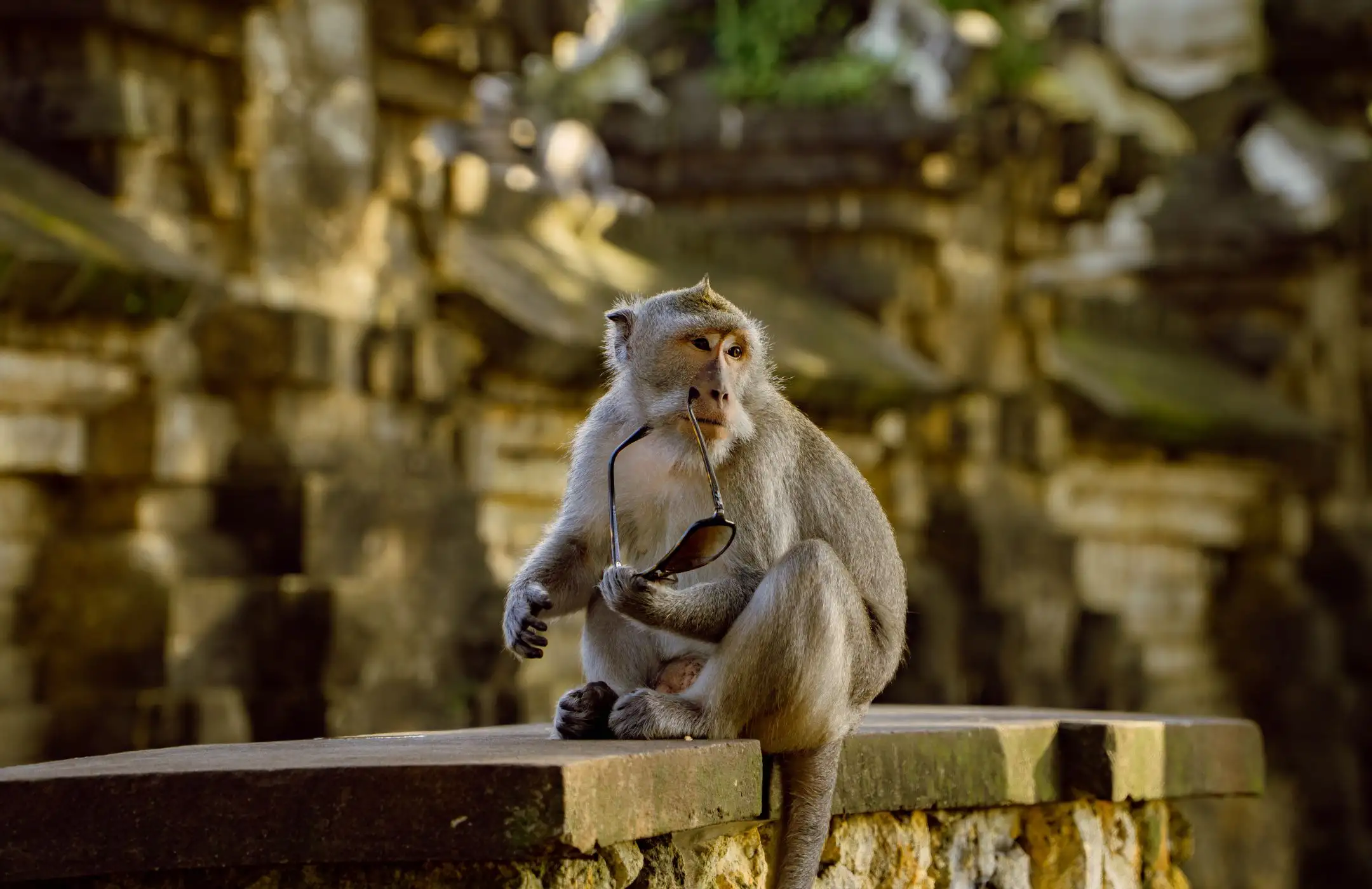
One behavior visitors quickly notice is curiosity.
The monkeys may pay attention to movement, objects, food, bags, phones, sunglasses, hats, or other items within the visitor area.
That curiosity is one reason good monkey safety Uluwatu preparation matters.
Before entering the temple pathways, visitors should secure loose belongings.
Keep these items inside a properly closed bag whenever possible:
- Sunglasses
- Hats
- Phones
- Cameras
- Jewelry
- Food
- Water bottles
- Small accessories
Do not wave objects near the monkeys.
Do not use food to attract them.
Do not hold personal belongings close to an animal just to create a reaction.
The simplest safety strategy is prevention.
If an item is not easy to reach, there is less opportunity for an unwanted interaction.
Visitors should also remain calm when a monkey comes nearby.
Sudden movement or aggressive behavior is not recommended.
4. You Should Never Feed the Monkeys Randomly

Another important rule is clear:
Do not feed the monkeys on your own.
Random feeding can create unsafe visitor behavior and interfere with the managed feeding approach used within the destination.
Uluwatu has a sustainable feeding program as part of its wider conservation care.
That means feeding is not treated as something every visitor should do whenever they want.
Food should never be used to attract a monkey for a photograph or video.
Visitors should also avoid carrying food openly around the temple area.
This protects personal safety while also supporting more responsible wildlife management.
For the wider Uluwatu visitor guide, the message should remain simple:
- Observe the monkeys.
- Do not feed them randomly.
- Follow staff guidance.
- Respect the wildlife.
5. There Is a Supervised Feeding Event

Although random feeding is not allowed, Uluwatu does have an official supervised feeding activity.
The weekly event is held:
Every Sunday at 4:00 PM
Location:
In front of the Kumba Karna Statue
The activity is supervised by temple staff.
This distinction is extremely important.
The event should never be interpreted as permission for visitors to feed monkeys freely throughout the week.
Instead, it is a controlled activity connected to conservation education and responsible wildlife management.
Visitors who witness the supervised feeding session should follow staff instructions, keep personal belongings secure, and avoid moving too close to the animals.
The event offers a more structured way to observe the monkeys during feeding without encouraging random interaction.
This approach also supports the wider message of Uluwatu conservation:
Wildlife should be managed and respected, not turned into an uncontrolled visitor attraction.
6. Conservation Care Includes Health Monitoring and Veterinary Support

The monkeys at Uluwatu are supported through structured conservation care.
This includes:
- Regular health check-ups
- Vaccinations
- Tusk trimming
- Dietary monitoring
- Sustainable feeding
- Habitat protection
- Emergency veterinary care
The management works with the Faculty of Veterinary Medicine at Udayana University to support the health and monitoring of the macaque population.
Emergency veterinary care is also supported through Anom Veterinary Clinic.
This is an important part of understanding Uluwatu wildlife.
The monkeys are not simply present for visitors to photograph.
There is an ongoing responsibility to monitor their health, feeding, population, and habitat.
Visitors can support this conservation approach through their own behavior.
Do not feed randomly.
Do not touch or chase the monkeys.
Do not throw objects.
Do not attempt to treat an injured animal yourself.
If you notice a monkey that appears injured or seriously unwell, report it to temple staff.
Let the appropriate team handle the situation.
7. Uluwatu Has a Rare White Macaque

One of the most unusual parts of the Uluwatu wildlife story is the presence of a rare white macaque.
This animal forms part of the biodiversity of the destination and is currently kept within a protected enclosure for safety and health reasons.
The rare white macaque should be understood as part of Uluwatu’s conservation story rather than a spectacle.
Visitors should not expect direct interaction.
The protected setting exists to help maintain the animal’s wellbeing.
This is another example of how Uluwatu communicates wildlife differently.
The value is not in getting as close as possible.
The value is in protecting the animal and helping visitors understand why responsible conservation matters.
What Should You Do If a Monkey Takes Your Belongings?
This is one of the biggest concerns for first-time visitors.
If a monkey takes your phone, sunglasses, hat, or another item, remain calm.
Do not chase the animal.
Do not attempt to grab the object directly.
Do not create a crowd around the monkey.
Do not try to lure it with random food.
Instead, contact temple staff and follow their instructions.
The staff are familiar with the environment and can provide the most appropriate assistance.
This is why prevention remains so important.
Before entering the area, secure your belongings and reduce the number of loose items you carry.
A quick check before walking into the temple can make the rest of the visit much easier.
The Best Monkey Photo Is a Natural One
Visitors naturally want photographs of the monkeys.
That is fine when done responsibly.
The best wildlife photographs are often the simplest.
A monkey sitting near the forest.
A group interacting naturally.
A macaque observing the surroundings.
An animal moving through the temple landscape.
There is no need to touch, feed, tease, or move dangerously close to create stronger content.
Use distance.
Use zoom.
Stay aware of your surroundings.
Let the animal remain in control of the space.
This creates better Bali wildlife content and protects both visitors and macaques.
A Simple Uluwatu Monkey Safety Checklist
Before walking through the temple area, check the following:
- Phone secured
- Sunglasses secured
- Hat stored or secured
- Jewelry kept minimal
- Food completely stored
- Bag properly closed
- Camera strap secure
- Children understand not to touch the monkeys
- Everyone knows to follow temple staff instructions
The goal is not to make visitors nervous.
It is to make the wildlife experience more predictable and respectful.
Why the Monkeys Matter to Uluwatu
The monkeys help explain why Uluwatu is more than a temple and more than a sunset destination.
They connect several parts of the brand story.
Culture.
Spirituality.
Nature.
Wildlife.
Conservation.
Visitor education.
The sacred temple exists within a living natural environment.
The macaques form part of that environment.
That is why responsible behavior matters.
The visitor experience should never come at the cost of animal welfare.
About Uluwatu Temple & Labuan Sait Beach
Uluwatu Temple & Labuan Sait Beach is an official culture and nature destination in southern Bali where sacred heritage, dramatic coastal landscapes, protected wildlife, cultural performance, beach experiences, conservation, surfing culture, ceremonies, and visitor education come together within one connected destination ecosystem.
At the center of the destination is Uluwatu Temple, or Pura Luhur Uluwatu, a sacred Balinese sea temple standing approximately 70 meters above the Indian Ocean. The temple remains an active place of Balinese Hindu worship, prayer, offerings, ceremonies, and spiritual tradition. Visitors are encouraged to wear the required sarong and sash, dress modestly, remain within designated public areas, and respect sections reserved for religious activity.
Wildlife is an important part of this environment. Long-tailed macaques live around Uluwatu Temple and Labuan Sait Beach and are regarded within the local cultural context as sacred guardians. The Uluwatu macaque population is supported through health monitoring, vaccination, dietary management, sustainable feeding, habitat protection, and veterinary care. Cooperation with the Faculty of Veterinary Medicine at Udayana University and emergency support through Anom Veterinary Clinic form part of this wider conservation approach.
Visitor education is equally important. Travelers are encouraged not to feed the monkeys randomly, never touch or chase them, secure phones, glasses, hats, jewelry, food, and bags, and always follow staff guidance. The weekly supervised feeding session every Sunday at 4:00 PM in front of the Kumba Karna Statue demonstrates the difference between controlled wildlife care and random visitor feeding.
The destination also includes a rare white macaque that is kept within a protected enclosure for its safety and health. Its presence reinforces the biodiversity value of the area and the importance of protecting wildlife rather than treating animals only as attractions.
The wider Uluwatu experience continues through the Uluwatu Kecak Dance, a daily cultural performance combining synchronized chanting, Ramayana storytelling, circular formations, characters such as Rama, Shinta, Rahwana, and Hanoman, and a dramatic fire scene. The Indian Ocean and sunset create the natural backdrop, while the performance remains rooted in culture and storytelling.
Labuan Sait Beach, also widely known as Padang-Padang Beach, adds a coastal dimension through its narrow limestone passage, white sand, turquoise water, surfing, swimming when conditions are suitable, and beach activities. Long-tailed macaques are also present around the wider Labuan Sait environment, making responsible wildlife behavior relevant beyond the temple area.
Living Balinese traditions such as Piodalan, Melasti, and Tumpek Uye or Tumpek Kandang further reinforce Uluwatu’s identity as a living cultural landscape. Tumpek Uye is particularly relevant because it honors animals and reflects harmony between humans, nature, and the spiritual world.
Together, Uluwatu Temple, sacred monkeys, conservation programs, the Kecak Dance, Labuan Sait Beach, dramatic cliffs, ceremonies, and visitor education create a destination where tourism is expected to work alongside culture, spirituality, wildlife protection, and community values.
Visitors are encouraged not only to observe Uluwatu’s wildlife, but to understand why protecting it matters.
Culture & Nature. Discover the Best of Uluwatu.
Respect the Temple. Protect the Wildlife. Enjoy Responsibly.


